
Devanahalli: From Temple Town to Growth Corridor
Twenty years ago, Devanahalli was a small town with a fort, a few temples, and agricultural land stretching in every direction. Then the airport came. And with the airport came roads, then jobs, then commercial development, then residential demand. This isn't speculation about what might happen. It already happened. The question now is how much further it goes.
The Airport Effect
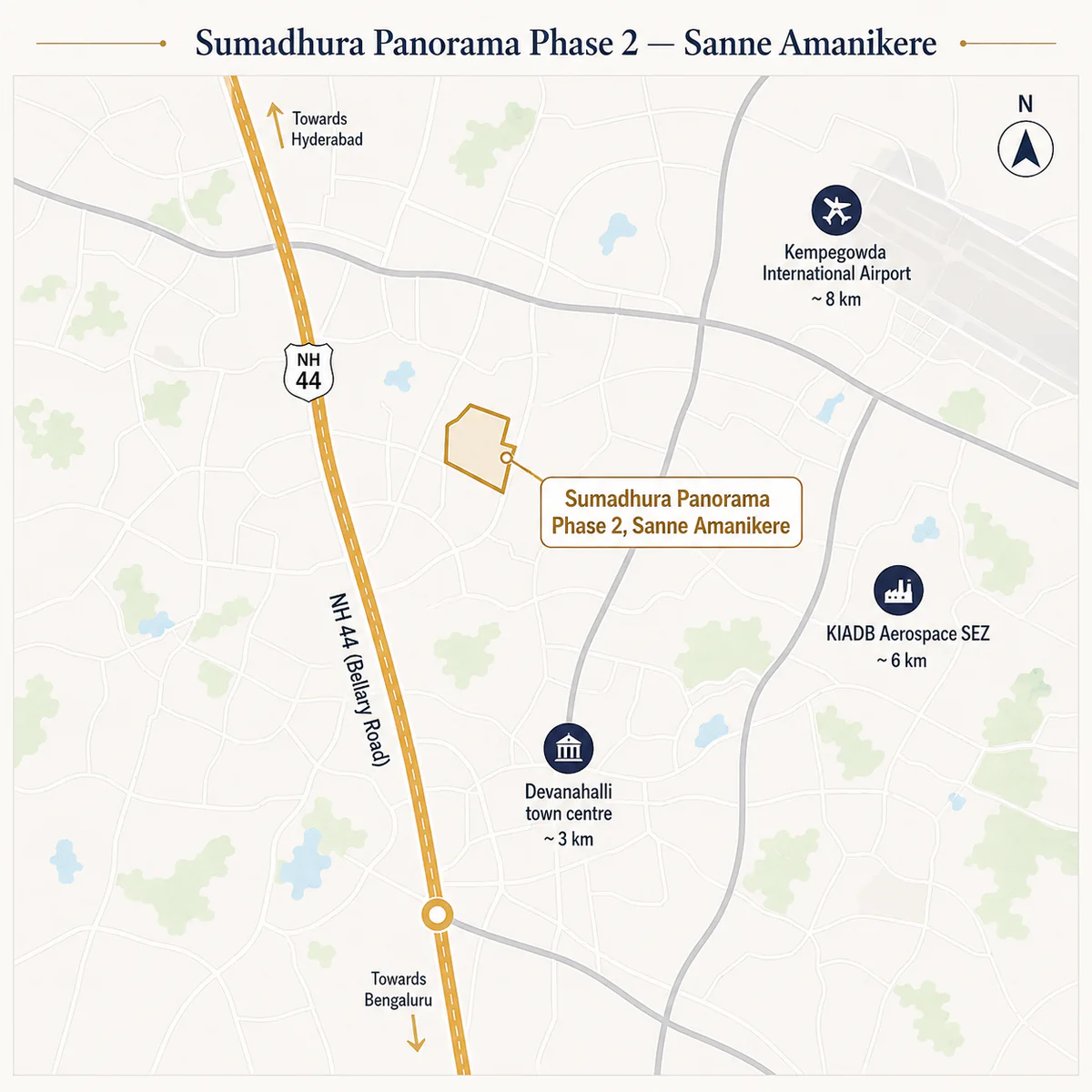
Kempegowda International Airport is approximately 8 km from Sumadhura Panorama Phase 2. The airport currently handles over 35 million passengers annually and is in the middle of a second terminal expansion that will roughly double its capacity. Every airport expansion in India has triggered a property cycle around it - Delhi's Dwarka, Mumbai's Navi Mumbai corridor, Hyderabad's Shamshabad belt. Bangalore's version of this is playing out in Devanahalli right now.
But the airport alone isn't the story. It's the ecosystem the airport pulls in. The Aerospace SEZ, KIADB industrial parks, IT campuses, and hospitality infrastructure create employment clusters that need residential support. People who work near the airport need homes near the airport. That demand is structural, not cyclical.
Connectivity Today and Tomorrow
The current road network centres on NH-44 (Bellary Road), which connects Devanahalli to Hebbal and the rest of Bangalore. The drive to Hebbal takes 35 to 45 minutes depending on traffic. That's not city-centre proximity, but it's comparable to commute times from Whitefield or Sarjapur - areas that are now considered mainstream Bangalore.
What changes the equation is the Namma Metro Phase 3 extension from Nagawara to the airport. When operational, this gives Devanahalli residents a direct metro connection to the city's core. The Satellite Town Ring Road (STRR) will add an orbital route connecting North Bangalore to the eastern and southern corridors without touching the city centre. These aren't announcements - they're funded, approved projects with construction timelines.
Social Infrastructure
The practical concern for families considering Devanahalli is schools, hospitals, and daily-needs retail. The area now has multiple options:
- Schools: Ryan International, Harvest International, Akash International, and several CBSE/ICSE options within a 10 km radius
- Healthcare: Aster CMI Hospital and Columbia Asia are accessible along the Bellary Road corridor
- Retail: Elements Mall in Thanisandra and commercial developments along NH-44 cover daily shopping needs
This isn't Indiranagar. You won't find a craft coffee shop on every corner. But the essentials are in place, and they're improving rapidly as population density increases.
The Investment Angle
Land prices in the Devanahalli belt have appreciated steadily over the past decade, driven by infrastructure spending rather than speculative demand. The corridor between the airport and Hebbal is Bangalore's most active infrastructure investment zone - metro, highway widening, flyovers, and commercial SEZs are all happening simultaneously. For plot buyers, this means the land you buy today sits in a corridor where the government is actively spending to improve connectivity and economic activity.
Compare this to saturated markets like Whitefield or Electronic City, where land is expensive and infrastructure is struggling to keep up with existing density. Devanahalli offers what those areas offered 15 years ago: good land at reasonable prices in a corridor where infrastructure is ahead of residential density. See the pricing page for current rates, or read the project overview for full specifications.